

What History Says About Mega IPOs
When excitement meets reality.

Tomorrow, SpaceX is expected to complete what could become the largest IPO in history.
Investors are excited. Financial media can’t stop talking about it. And many investors are already asking the same question: Should I buy it?
Before answering that question, it may be worth looking at what happened to the biggest IPOs that came before it.
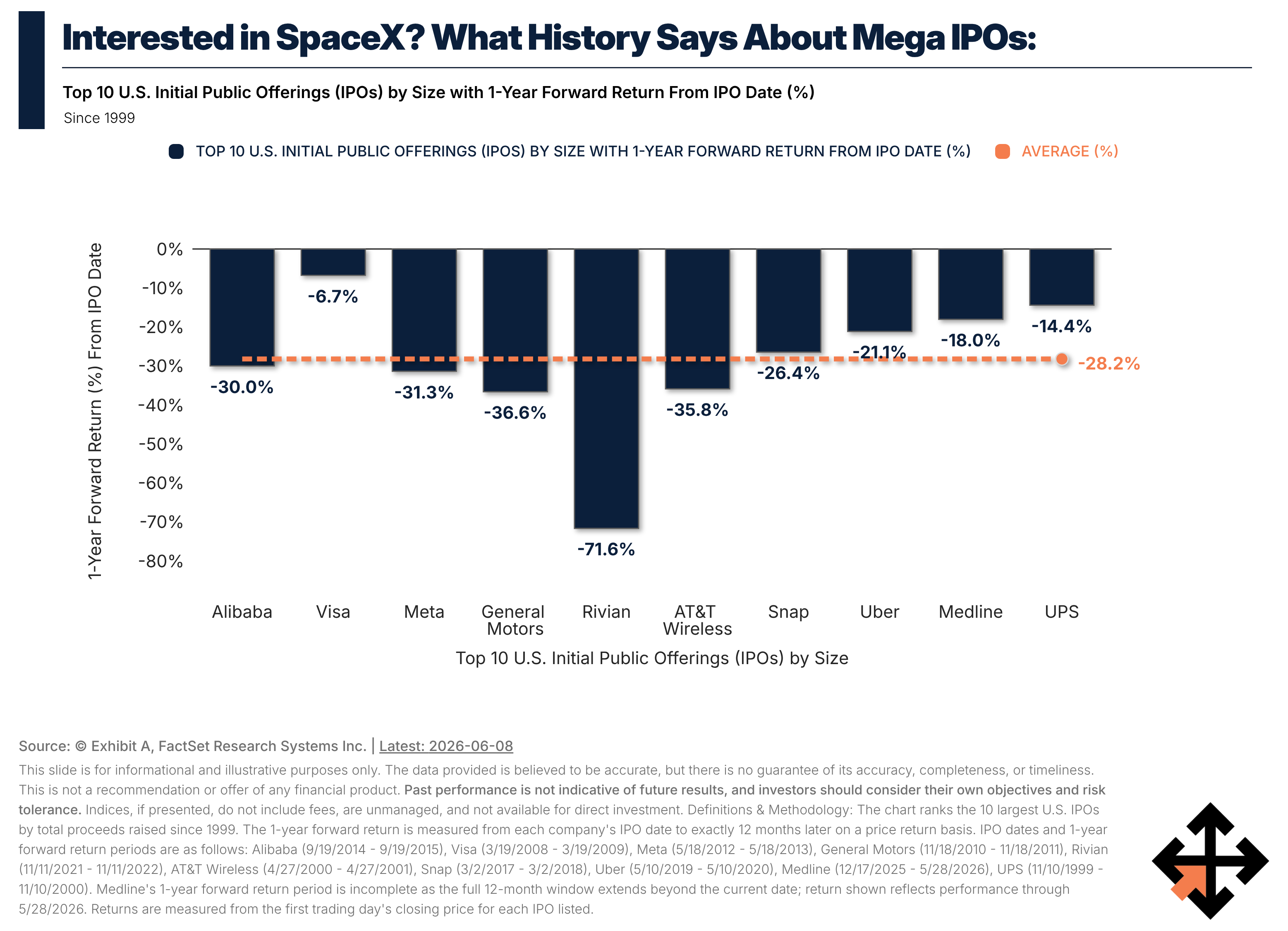
Every One Of Them Was Down
The ten largest U.S. IPOs since 1999 have something remarkable in common.
Every single one produced a negative return during its first year as a public company.
Not some. All of them. The average return? -26.8%.
That’s not a prediction for SpaceX.
But it is a reminder that investor excitement and investment returns are often two very different things.
Why Does This Happen?
Because investors often confuse a great company with a great investment.
They’re not always the same thing.
By the time a company reaches the largest IPOs in history:
excitement is already high,
media coverage is everywhere,
institutional demand is strong,
and expectations are often sky-high.
Investors aren’t just buying a business.
They’re buying a story.
And stories can become expensive.
The challenge isn’t whether these companies are good businesses.
Many of them are.
Meta became one of the most successful companies in history.
Alibaba became a global giant.
Uber transformed transportation.
The problem was valuation.
Investors paid prices that assumed years of future success would arrive immediately.
When reality failed to match expectations, share prices suffered.
But Not All IPOs Are Struggling
To be fair, recent IPOs have produced better results than the historical data might suggest. According to DataTrek Research, the 15 largest U.S. IPOs completed this year are up an average of 31.1% from their offering prices.
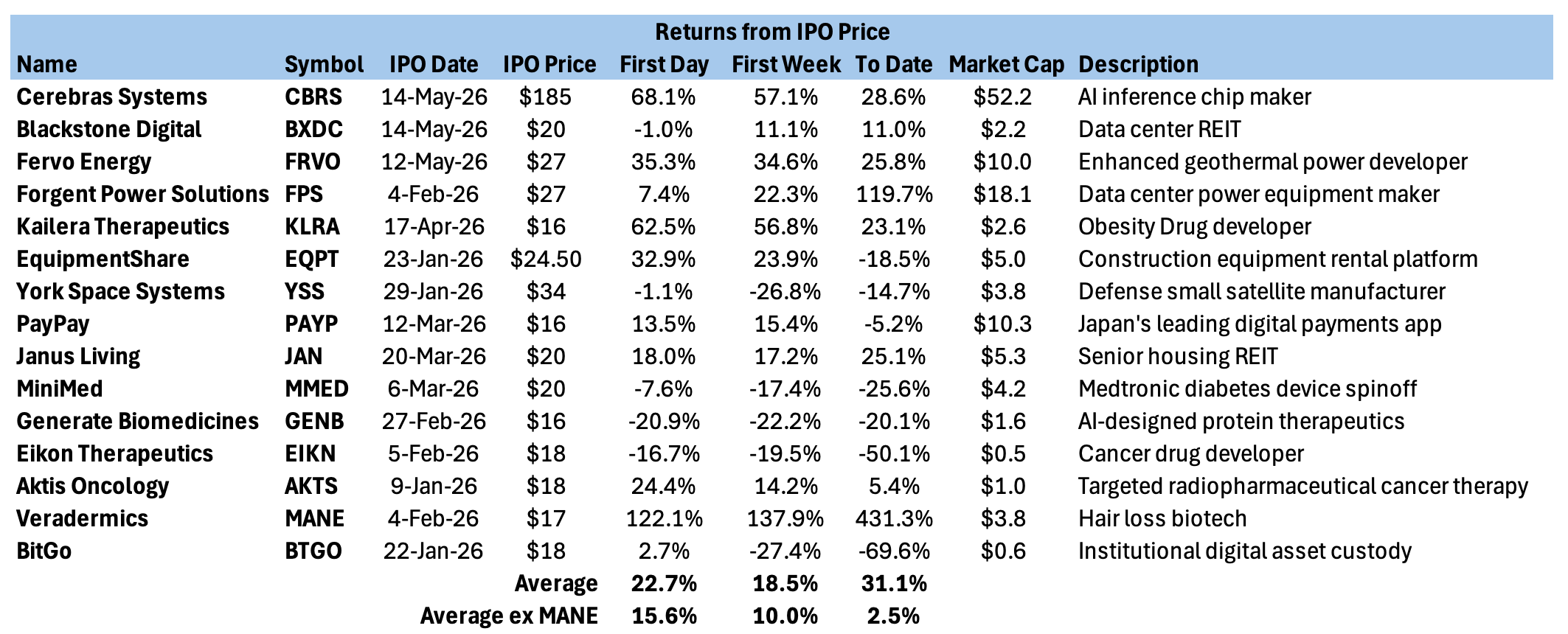
At first glance, that sounds impressive. But there’s an important catch.
One company—CoreWeave—accounts for much of that performance.
Excluding CoreWeave, the average return falls to just 2.5%.
In other words, today’s IPO market appears open, but highly selective.
Investors have rewarded companies benefiting from powerful trends such as AI infrastructure and energy, while showing far less enthusiasm for speculative, pre-revenue, or unprofitable businesses.
That’s an important distinction.
Because while history provides useful context, every IPO ultimately writes its own story.
And investors considering SpaceX must decide whether it becomes the next exceptional winner—or another example of expectations getting ahead of reality.
The IPO Trap
One of the biggest mistakes investors make is assuming that popularity reduces risk.
In reality, popularity often increases risk.
When everyone wants to own the same stock:
valuations rise,
expectations rise,
and the margin for error shrinks.
That doesn’t mean the company will fail.
It simply means investors may be paying too much for future growth.
History suggests that the biggest IPOs often arrive at the exact moment optimism is highest. Unfortunately, that’s not always the best time to invest.
What This Means For SpaceX
None of this means SpaceX will follow the same path.
It may become one of the most important companies of the next generation.
Its combination of satellite communications, launch services, AI infrastructure, and defense capabilities is unlike anything we’ve seen before.
But history does offer an important reminder:
The quality of a company and the quality of an investment are two different things.
Investors should be careful not to let excitement, headlines, or fear of missing out drive their decision-making.
The companies that change the world are not always the best investments on day one.
The Bigger Lesson
The lesson isn’t really about SpaceX.
It’s about discipline.
Successful investing isn’t about owning every exciting opportunity.
It’s about knowing when expectations have already gotten ahead of reality.
Sometimes the best investment decision isn’t what you buy.
It’s what you choose not to chase.
Related Reading
Earlier this week, we took a deeper look at the SpaceX IPO itself, including the company’s business model, valuation, Elon Musk’s control, and the role of investor psychology.
Read it here: The SpaceX IPO: Now What?
