

The K-Shaped Economy: Two Different Paths
The economy is growing. So why doesn't it feel that way for everyone?

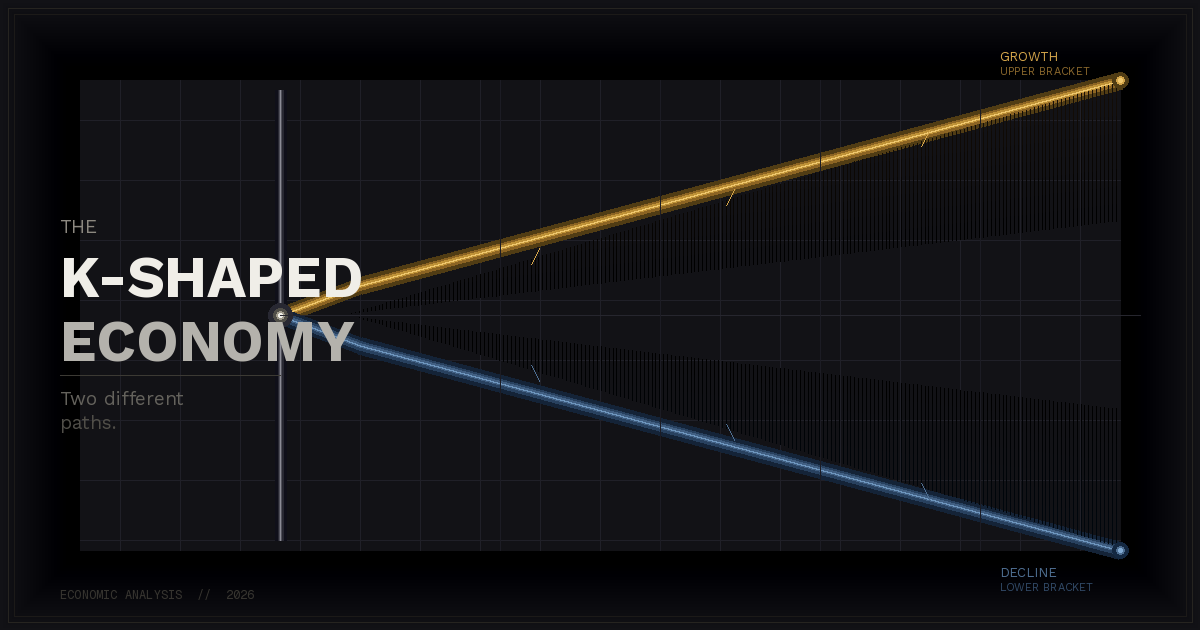
Start With the Letter K
Picture the letter K. It has two arms — one pointing up, one pointing down.
That’s the simplest way to understand what’s happening in our economy right now. Instead of everyone moving forward together, the economy has split into two groups: one that’s getting ahead, and one that’s falling behind.
Economists call this a K-shaped economy.
Two Very Different Experiences
Think about two people living in the same city.
The first person works in an office — or from home — earns a good salary, owns their home, and has some money saved in a retirement account or investments. Over the last few years, their home went up in value. Their savings grew. Life got more expensive, but their income kept pace.
The second person works in a restaurant, a store, or a warehouse. They rent their home. They don’t have investments. When prices went up for groceries, rent, and gas, their paycheck didn’t stretch as far. They may have lost work during tough economic times and came back to a job that paid roughly the same — while everything around them cost more.
Same economy. Completely different reality.
That gap — between those moving up and those falling behind — is the K-shape.
Why Is This Happening?
There’s no single cause. It’s a combination of factors that have been building for years.
Owning things grows wealth — not owning things leaves you behind. When the stock market goes up or house prices rise, the people who already own stocks or real estate see their net worth increase. If you don’t own either, you don’t see any of that benefit. In fact, rising house prices can make the situation worse because now buying a new home may feel further out of reach.
Some jobs survived the modern economy better than others. Work that can be done on a laptop from anywhere held up well through recent economic disruptions. Work that requires you to show up in person — serving food, stocking shelves, caring for people — was hit much harder. Those workers had no option to work from home. And their jobs tend to pay less, offer fewer benefits, and provide less security.
The cost of living keeps climbing, but wages haven’t kept up for everyone. Rent, groceries, healthcare, childcare — the basics of life have gotten significantly more expensive. For people in higher-paying jobs, raises and bonuses have generally kept pace. For lower-wage workers, the math just doesn’t add up the way it used to. More and more people are using credit cards or payment plans just to cover everyday expenses — not luxuries, but necessities.
New technology is widening the gap. Tools like artificial intelligence are making some workers dramatically more productive and valuable. But that benefit isn’t shared equally. It tends to flow to people who already have specialized skills and education, while doing little — or potentially causing harm — to workers in routine jobs that are easier to automate.
You Can See It Everywhere, Once You Know What to Look For
The K-shape shows up in everyday life in obvious ways once you start noticing it.
Companies are responding to it directly. Luxury brands are posting record sales. At the same time, fast food chains are rolling out budget menus and smaller portion sizes to keep customers who are watching every dollar. Businesses are essentially designing two entirely different products for two entirely different economies.
High-end neighborhoods are booming with new restaurants and development. A few miles away, longtime residents are being priced out of homes they’ve rented for decades.
Job postings for highly skilled, well-paid roles remain competitive. Meanwhile, lower-wage workers are seeing hours cut and less job security.
Two economies, side by side.
Why It Matters
Beyond fairness, there’s a practical concern here that economists take seriously.
When the gap gets wide enough, it becomes a problem for the entire economy — not just the people at the bottom. Consumer spending is what keeps businesses running and the economy moving. If the majority of that spending is now coming from a small group of wealthy people, the whole system becomes fragile. A bad stretch in the stock market, a housing slowdown, or a dip in wealthy consumers’ confidence could ripple outward and affect everyone.
Inequality, at a certain point, stops being just a social issue and starts being an economic risk.
The Takeaway
A K-shaped economy is what happens when growth and recovery aren’t shared equally. The headline numbers say one thing. The lived experience of millions of people says something very different.
Understanding this doesn’t require a finance degree or any background in economics. It just requires looking at who the economy is actually working for — and being honest about the answer.
If you made it to the end, I’ll give the credit of this write-up to Claude AI. In the growing world of artificial intelligence, I thought it would be fun to ask a few AI engines to write me an answer and explain it so that a high school student could understand. I asked Google’s Gemini, Anthropic’s Claude AI and OpenAI’s ChatGPT for the same, have them each evaluate each others work and choose the one that I thought hit the concept the best. The time efficiency of these new tools is great, and they available to everyone.