

🔥🐎 The Fire Horse Is Back
1966 vs. 2026: Are We Entering Another Turning Point?

Every 60 years, the Chinese zodiac brings back the Fire Horse.
The last one was 1966.
The next one is 2026.
Now, I don’t invest based on zodiac cycles.
But history doesn’t repeat, it rhymes.
And when you step back and compare the environment of 1966 to what we’re seeing today, the parallels are worth paying attention to.
What Is a “Fire Horse”?
In the Chinese zodiac, animals rotate through five elements — wood, fire, earth, metal, and water — creating a 60-year cycle.
The Horse represents:
Energy
Speed
Independence
Momentum
Add Fire, and it amplifies everything:
Intensity
Risk-taking
Rapid change
Leadership
Volatility
Fire Horse years are traditionally described as bold, disruptive, and fast-moving.
Whether you believe in astrology or not, it’s an interesting metaphor for moments in history when things begin to accelerate and shift.
1966: A Turning Point
1966 didn’t bring a catastrophic crash.
It brought something more subtle and ultimately more important.
It marked the end of an easy market regime.
The S&P 500 peaked in early 1966 and dropped nearly 20%. But the bigger story came afterward.
From the late 1960s into the early 1980s:
Markets largely moved sideways
Inflation accelerated
Valuations compressed
Real (after-inflation) returns were weak
Volatility increased
The environment changed.
And investors who were used to easy returns suddenly faced a much more complicated market.
2026: A Familiar Set of Pressures
Now look at the environment today.
Several structural forces look surprisingly similar.
1️⃣ Market Concentration
Recent market gains have been driven heavily by a small group of mega-cap companies.
We saw something similar in the late 1960s with the “Nifty Fifty” — a handful of dominant companies that investors believed could only go up.
History shows concentration can work… until it doesn’t.
2️⃣ Inflation Isn’t Fully Gone
After a decade of ultra-low inflation, the post-2020 period reminded everyone that inflation can return quickly.
Even now, economists expect inflation to remain above the Federal Reserve’s 2% target for some time, especially as geopolitical tensions affect energy prices.
3️⃣ Energy Shocks Are Back in the Conversation
Recent geopolitical tensions in the Middle East have pushed oil prices sharply higher and reignited fears of supply disruptions through the Strait of Hormuz — a key route for global energy markets.
Energy shocks like these have historically been one of the fastest ways inflation reenters the global economy.
It’s one reason markets become more volatile when geopolitical risks rise.
4️⃣ Technological Acceleration
1966 had the space race and industrial expansion.
2026 has AI, data centers, and massive technology investment cycles driving economic growth and market leadership.
Both periods feel transformational.
And transformational periods often create both opportunity and instability.
Then vs. Now: Nifty Fifty vs. Magnificent 7
One of the most interesting parallels between the late 1960s and today is market concentration.
In the late 1960s and early 1970s, investors believed a group of companies known as the “Nifty Fifty” were untouchable.
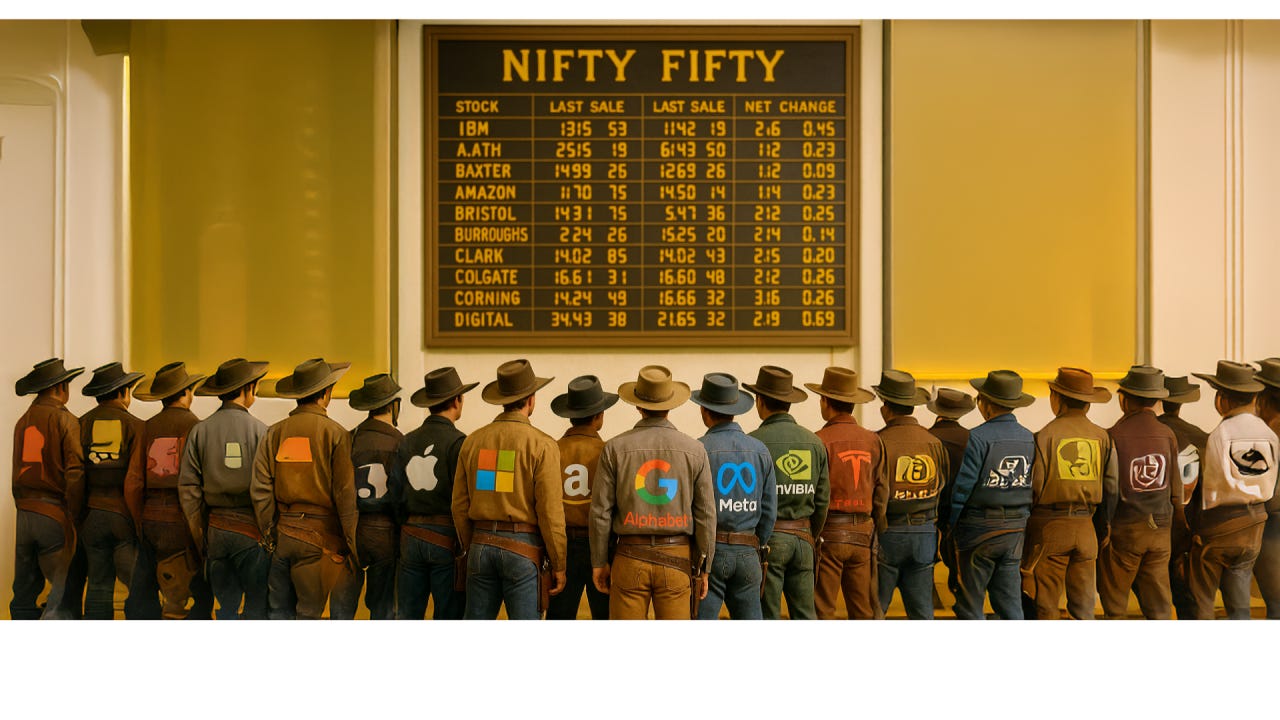
These included names like:
IBM
Coca-Cola
McDonald’s
Xerox
Polaroid
They were considered “one-decision stocks.” Buy them. Hold them forever.
Sound familiar?
Today, we have the Magnificent 7:
Apple
Microsoft
Nvidia
Amazon
Alphabet
Meta
Tesla
These companies are extraordinary businesses.
But history reminds us of something important:
Even great companies can become over-owned when optimism peaks.
And when leadership becomes too concentrated, markets can become fragile.
The Real Lesson
This isn’t about predicting doom.
It’s about recognizing regime shifts.
1966 wasn’t the start of disaster.
It was the start of a different investing environment, one where:
Inflation mattered again
Valuations mattered again
Volatility increased
Diversification became more important
In other words, the rules changed.
The Sandbox Lens
If the Fire Horse symbolizes acceleration and intensity, then maybe the lesson for investors is simple:
Markets don’t move in straight lines forever.
Sometimes they shift.
From:
Easy returns → more selective opportunities
Narrow leadership → broader rotations
Momentum → discipline
The question isn’t whether 2026 will repeat 1966.
The real question is: If the environment changes, are you positioned for resilience or just momentum?
History doesn’t repeat. But it does rhyme.
And disciplined investors are the ones who survive these regime changes.
To review your personal financial plan or discuss any financial items in more detail, please reply to this email or contact us here to schedule a meeting.