

Roth IRA: The 59½ Rule Isn’t What You Think
Your Roth IRA Has 3 Layers. Most People Only Know One.

Imagine a piggy bank that grows your money completely tax-free.
Most people think it’s locked until age 59½.
It’s not.
In reality, it has three different access points and most people only know one.
Before we discuss, here is some context.
What Is a Roth IRA?
A Roth IRA is one of the most powerful accounts in the tax code.
You contribute after-tax dollars, it grows tax-free, and qualified withdrawals are completely tax-free.
No future tax bill. No surprises.
And yet, most people misunderstand how flexible it actually is.
Here’s what most people miss:
Millions of Americans have a Roth IRA but many don’t fully use it.
One big reason?
They think the money is locked away until 59½.
That’s only partially true.
👇 Here’s the part most people don’t understand, there are 3 Layers to the Roth IRA:
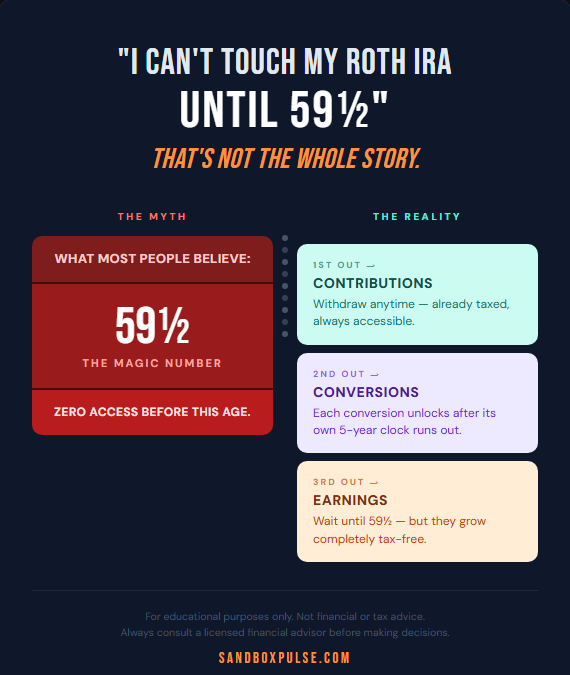
The Real Rules: 3 Layers of Money
Think of your Roth IRA like a three-layer system.
Each layer has its own rules.
And when you take money out, the IRS forces withdrawals in a specific order—starting with the most accessible.
Layer 1 — Contributions (Most Accessible)
This is the money you put in.
Because you already paid taxes on it, you can withdraw it anytime—no taxes, no penalties, no waiting.
Whether you’re 25 or 55, your contributions are always yours.
Layer 2 — Conversions (Middle Ground)
This is money moved from a Traditional IRA or 401(k) into a Roth.
You pay taxes upfront—then it grows tax-free.
Each conversion has its own 5-year clock before it can be accessed penalty-free.
This is where strategy comes in.
Many investors build a “Roth Conversion Ladder”—unlocking funds over time so they’re available when needed.
Example:
Convert $50,000 in 2024 → accessible in 2029
Convert $60,000 in 2025 → accessible in 2030
Convert $70,000 in 2026 → accessible in 2031
Layer 3 — Earnings (Most Valuable)
This is the growth and where the real power of a Roth lives.
To access it tax-free, you must be 59½ and have held the account for at least 5 years.
Wait long enough, and this could mean hundreds of thousands of dollars… completely tax-free.
Why This Matters
The IRS forces withdrawals in this order:
Contributions (always accessible)
Conversions (after 5 years)
Earnings (last—and most restricted)
That’s a big advantage.
It means early withdrawals typically come from the most flexible dollars first—without touching long-term growth.
The Bottom Line
Don’t let “59½” stop you from using one of the most powerful accounts available.
A Roth IRA isn’t just a retirement account.
It’s a flexibility tool. A tax strategy. A long-term wealth engine.
Used correctly, it can help fund early retirement, smooth income gaps, and create tax-free wealth for decades.
The key is simple: Understand the layers and plan around them.
Final Thought
Everyone’s situation is different.
In many cases, it still makes sense to let Roth assets grow as long as possible.
But the right strategy depends on your full financial picture.
If you’re unsure how this fits into your plan, that’s where thoughtful guidance matters.