

Retirement’s Most Overlooked Expense
What healthcare really costs in retirement

It’s not travel.
It’s not housing.
It’s healthcare.
And for many retirees, it’s the one cost that quietly disrupts an otherwise well-built plan. According to recent research from Fidelity:
A 65-year-old retiring today is expected to spend $172,500 on healthcare in retirement.
That’s not a worst-case scenario.
That’s the average.
Where the Money Actually Goes
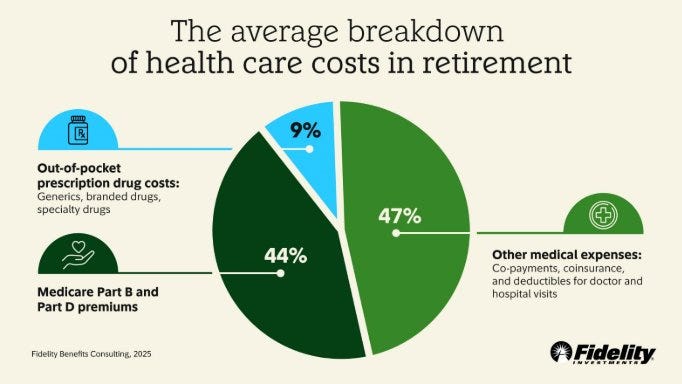
What surprises most people isn’t just the total, it’s the composition.
Nearly half of healthcare costs in retirement come from general medical expenses like co-pays, coinsurance, and deductibles.
Another large portion? Medicare premiums.
And then there are prescription drug costs, which can vary widely depending on health and coverage.
But here’s what that number doesn’t include:
Long-term care
Most dental and vision expenses
Unexpected or catastrophic health events
Which means the real number for many families is… higher.
The Real Risk Isn’t Just the Cost
It’s the timing.
Healthcare costs don’t show up evenly.
They tend to:
Spike later in life
Coincide with reduced flexibility
Hit when portfolios are more vulnerable to withdrawals
This creates a dangerous combination: higher expenses + less time to recover.
Where Most Plans Fall Short
As a financial planner, I see this all the time:
People build thoughtful retirement plans around:
Income
Lifestyle
Travel
Legacy
But healthcare?
It’s often treated as a line item and not a risk.
And that’s where plans begin to crack.
How to Plan for It (The Right Way)
This isn’t about guessing the exact number.
It’s about building a plan that can absorb the uncertainty.
Here’s how we think about it:
1. Stress Test the Plan
Run scenarios that assume:
Higher-than-average healthcare costs
Earlier or more frequent withdrawals
Inflation specifically tied to healthcare (not just CPI)
2. Use the Right Buckets
Not all dollars should be treated the same.
Tax-free accounts (Roth) → ideal for unexpected or large healthcare costs
HSAs (if available) → triple tax advantage, purpose-built for this
Taxable accounts → flexibility for ongoing expenses
3. Plan for Long-Term Care
Long-term care insurance isn’t right for everyone.
But the conversation should start early.
This is something we begin discussing with clients in their 50s, when there are still options, flexibility, and time to plan intentionally.
Because by the time many people start looking into long-term care…
It’s too late
It’s too expensive
Or it’s no longer available
You don’t have to buy a policy. But you do need a plan.
Whether that means:
Self-funding
Hybrid policies
Or earmarking specific assets
The key is making the decision early and on your terms.
Ignoring it is still a decision, just not a good one.
4. Protect the Downside
Healthcare costs become most dangerous during:
Market downturns
Early retirement years (sequence risk)
This is where portfolio structure matters:
Cash buffers
Income layering
Diversification beyond just stocks
5. Revisit the Plan Regularly
Healthcare is not static.
Costs, coverage, and personal health evolve.
Your plan should too.
The Bottom Line
Retirement isn’t just about having enough.
It’s about protecting what you’ve built from the risks that are hardest to predict.
Healthcare is one of them.
And for many families, it’s the difference between:
A plan that works on paper
And a plan that works in real life
If you’re not sure how healthcare fits into your retirement plan, it’s worth a conversation.
Because the goal isn’t just to retire.
It’s to stay retired, comfortably and confidently.
At Sandbox, we help you do exactly that, so you can live more and worry less.