

A Financial Head Start for America’s Kids
530A Accounts explained, backed by government and philanthropy.

This Giving Tuesday, it’s the perfect moment to highlight a groundbreaking development designed to improve long-term financial opportunity for millions of American children.
The federal government has introduced a new tax-advantaged savings and investment program. Originally referred to as “Trump Accounts,” now being rebranded as 530A Accounts with the goal of giving every child a meaningful financial foundation for the future. In the past 24 hours, this initiative gained historic momentum thanks to one of the largest philanthropic commitments ever made to children in the United States.
Here’s a clear, non-political overview of what 530A Accounts are, who qualifies, and why this program is quickly becoming a major topic for families and financial planners.
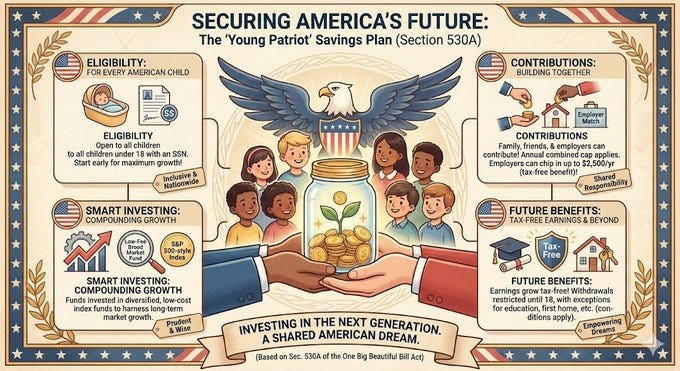
Accounts are not yet available through custodians or brokerage firms. The federal agencies responsible for implementation are still finalizing rules. As soon as clear guidance and timelines are published, we’ll share updates to help families take action.
(December 2, 2025)
What Are 530A Accounts?
A 530A Account is a new federal savings and investment vehicle designed specifically for children under age 18.
The purpose is simple:
Give every child a starter investment account and a pathway to build long-term financial security.
These accounts are intended to support major life milestones, including:
Education or career training
First-time home purchase
Starting or buying a business
Adoption or childbirth expenses
Rolling balances into retirement savings in adulthood
General long-term investing after age 30 (based on draft rules)
Money inside the account grows tax-free when used for qualified purposes.
Who Is Eligible?
Any U.S. child under age 18 with a valid Social Security Number can have a 530A Account.
There are no income limits for parents or guardians.
The U.S. Treasury will automatically open these accounts for newborns (2025-2028).
Why the Name Is Changing
Although originally referred to as “Trump Accounts,” lawmakers and regulators are moving toward the neutral, tax-code-based name “530A Accounts.”
The reasoning:
Reduce political branding
Ensure long-term bipartisan durability
Align with programs like 529 plans and 401(k)s
Make communication simpler and more universal
The structure of the program remains the same with only the name is becoming more neutral and familiar to families.
Historic Philanthropy: The Dell Donation
On December 2, 2025, Michael & Susan Dell announced a $6.25 billion donation to help fund 530A Accounts for children who are not eligible for the federal $1,000 deposit. (Read more)
Their pledge will provide:
$250 deposits
For approximately 25 million children
Ages 10 and under
Born before 2025
Living in ZIP codes with median family income under $150,000
This is one of the largest philanthropic commitments ever made to U.S. children. It ensures that many kids who missed the 2025–2028 federal seed window still receive meaningful early savings.
Corporate and Employer Interest Is Growing
The Dell gift may be just the beginning.
Several large companies and business leaders have publicly expressed support for contributing to 530A Accounts, including matching contributions for employees’ children. The structure of the program allows:
Parents and grandparents
Employers
Foundations and nonprofits
Local community groups
High-net-worth donors
…to contribute to a child’s account above the federal baseline.
Early draft rules suggest annual contribution caps in the $2,500–$5,000 range, with employers able to contribute up to half of that.
Momentum is building for broader public-private support.
How Funds Can Be Used (Tax-Free)
Qualified uses include:
Tuition, trade schools, apprenticeships
First-time home purchase
Starting a business
Adoption/childbirth expenses
Retirement rollover in adulthood
Certain long-term investing uses after age 30
Non-qualified withdrawals may be taxed and penalized, similar to Roth IRAs or 529 plans.
Why 530A Accounts Matter
530A Accounts are designed to:
Help children begin adulthood with real assets
Encourage investing and saving from birth
Support education, entrepreneurship, and homeownership
Provide families with a new tax-advantaged planning tool
Narrow wealth gaps through early financial compounding
Leverage both government funding and philanthropic support
With the federal pilot program and the massive Dell donation, these accounts instantly become one of the most impactful new financial initiatives in decades.
Final Takeaways for Families
Here’s the simple version:
Every child under 18 is eligible for a 530A Account
Kids born 2025–2028 receive a $1,000 federal deposit
Millions of kids born before 2025 will receive $250 from the Dell donation
Tax-free growth for education, home buying, business creation, and more
More private and corporate support is likely coming
The program is intentionally being depoliticized and renamed “530A Accounts”
This is a new, evolving, and promising tool for families planning ahead and we’ll continue sharing updates as more guidance is released.